How thirty-three national federations, the ITTF and the ETTU turn match results into a number. The rules below are taken from each federation's current published rulebook (checked October 2026), and the points tables are the real ones.
Contents
1. Four families of systems
2. One match, fifteen rulebooks – calculator and charts
3. The comparison table
4. Country by country
5. How to read the numbers
6. Estimate equivalence tables – men and women
1. Four families of systems
2. One match, fifteen rulebooks – calculator and charts
3. The comparison table
4. Country by country
5. How to read the numbers
6. Estimate equivalence tables – men and women
If you have extra information, another source or any comments, please contact Jacek Offierski – especially for countries where no published method could be found: Hong Kong, India, South Korea and the African federations (see 1.5).
This is not official information from any table tennis federation. For official information on the ranking system of the Dutch table tennis federation (NTTB), see the page 👉Elo ranking – explanation and method of calculation.
This page was compiled with the help of AI (Claude) from the federations' published rules (checked October 2026) and reviewed by Jacek Offierski.
| 1. |
FOUR FAMILIES OF SYSTEMS |
| A rating estimates playing strength from results against opponents: every match moves the number, depending on the opponent. A ranking orders players by points earned from placings or wins at counting events. A league score summarises a season in team leagues. Each answers a different question, and many federations combine them. Which type of system fits a country depends largely on how many results are available. A per-match rating needs many trustworthy results. Where players have only a few official matches a year, for example where only tournaments count as official or where other matches are not supervised well enough to be trusted, a pure Elo rating moves too slowly and stays uncertain, so federations tend to use a placement ranking or a system that tracks uncertainty (👉Glicko, 👉Bayesian). Where every player plays several official matches a week, for example in a league, a per-match rating (Elo or one of its successors) is the only way to use all of those results; a placement ranking would ignore them. The Dutch NTTB-Elo, for example, had processed almost 5 million matches from 2008 to 2026, about 270,000 a year (👉NTTB rating database). Other sports show the same pattern: in chess, FIDE gives a player new to the rating list a larger change factor (K = 40) until 30 rated games, because an Elo rating needs many games to settle (👉FIDE Rating Regulations, 8.3.3); online chess rates its games with Glicko-2 (👉Lichess); and in tennis, where players meet in tournaments, the ATP ranking adds points for the round reached (👉ATP rankings FAQ). |
|
| 1.1. | FORMULA RATING (Austria, Estonia, Finland, Germany, Scotland, Spain, Ukraine). An 👉Elo, 👉Glicko or 👉Bayesian formula works out each player's chance of winning, and the rating moves by the difference between the result and that chance. Glicko and Ratings Central also track how certain each rating is. |
| 1.2. | POINTS-TABLE RATING (Netherlands, Denmark, England, France, Greece, Ireland, Latvia, Lithuania, Norway, Sweden, Switzerland, USA). The idea is the same as 👉Elo, but the points come from a lookup table: a rating gap band and who won give a fixed number of points. This is the most common approach in Europe. |
| 1.3. | PLACEMENT RANKING (Croatia, Hungary, Italy, Poland, Portugal, Romania, Serbia, Slovenia, Wales, ETTU, ITTF). Points come from how far you get in counting tournaments and are summed over a season or rolling window. Who you beat matters little or not at all, and a loss never costs points. Croatia and the ETTU add points for every win according to the opponent's rank; Italy, Portugal, Slovenia and Wales add points per league win; Wales gives points only for wins, with a fixed value per league division or tournament stage. |
| 1.4. | LEAGUE SCORE (Czechia, Slovakia, Turkey). A season score from your record in team leagues, weighted by how strong the league is; Czechia and Slovakia add bonuses for championships and world ranking. Published once or twice a year to set team line-ups. |
| 1.5. |
OTHER CONTINENTS Only the type of system, to compare with the families above: Africa – no published national rating method could be found. Americas
Two ideas not seen in the European systems on this page:
Sources: CBTM Manual Tênis de Mesa Brasil 2024 · TTCAN Rating System (2016) · Table Tennis Canada rankings · China Daily on the CTTA skill-level test (17 Jul 2026) · TV Tokyo on the Paris 2024 selection points · Japan Table Tennis Rating Promotion Council (Kansai University) · TTAB (Baroda, Gujarat): ranking and seeding rules 2025 · STTA National Ranking System (Feb 2025) · Ratings Central users · TTA Ratings Central guidelines · TTNZ ranking system
|
| 2. |
ONE MATCH, FIFTEEN RULEBOOKS |
|||||
| 2.1. |
Choose a rating gap and who wins. Each row applies that country's real points table to a normal league or base-weight match. Each country uses its own scale, so a 100-point gap in Germany means more than 100 points in the Netherlands.
Who wins
Assumptions: NL is a league match (weight R1). AT is interpolated from the ÖTTV published examples for two players with standard deviation 50. BE is the AFTT (Wallonia) table for an interclub match at coefficient 1 (N1–N2), where the loser pays 80%. CA uses the 1-star table (the lowest of four event tiers). EN uses weighting 1.0. FI uses the published formula (one match, no daily cap). FR is a team championship match (coefficient 1). DE uses change constant 16, an adult with 30+ singles. GR uses coefficient 1 (local leagues; the A1 league counts ×4 for the winner). IE counts match points only, at factor 1 (e.g. the National Team Tournament); placing points come on top. LV uses coefficient 1 (e.g. the 3rd league). NO uses event weight 1 (league). ES treats both players as established (RD at its minimum of 50). SE is a league match. US uses the tournament exchange chart. Austria, Germany and Spain calculate per event, so with several matches the numbers combine and are not simply added up.
|
|||||
| 2.2. |
The same fifteen rulebooks as lines: points for the winner by rating gap, with the same assumptions as the calculator. Points tables are drawn as a smooth curve through the first gap of each band where the points change, formulas as their exact curve; the exact steps are in the calculator above. Each line ends where its table or formula ends: Ireland at 71, USA at 238, Netherlands at 300, Finland where its formula reaches its limit, Austria at 400 (last published example), Belgium and Canada at about 400, France, England and Latvia at about 500, Sweden at 501. Norway (600) and Greece (750) end beyond the chart; Germany and Spain have no end. The countries use different rating scales, so the same gap is not the same difference in playing strength: the charts show how each system rewards a result, not which country is stricter.
Expected result: the favourite wins
Unexpected result: the underdog wins
|
| 3. |
THE COMPARISON TABLE |
| 3.1. | Most federations keep two things apart: the rating that is recalculated and published as results come in, and the official reference value that is frozen on fixed dates and used for licences, classes, seeding and team line-ups. The table shows both. Countries are listed alphabetically, with the Netherlands first and the ETTU and ITTF last; the whole page uses this order. |
| Country | System | Type | Rating updated / official reference value | New players start | Distinctive rule |
|---|---|---|---|---|---|
| 🇳🇱 Netherlands | NTTB-Elo | Elo-based points tables | Rating: Calculated daily and published, so players can follow it Official: Twice a year, 1 Jan and 1 Jul: licences, which are used for placing in competition and tournaments |
Average of the two best players beaten | Tournament weight R0–R5 (×0.5–×2) boosts the winner only; the loser always pays the R1 value |
| 🇦🇹 Austria | Ratings Central | Bayesian | Rating: Weekly: Sunday cut-off, published on Tuesday Official: Each tournament names in its invitation the date of the weekly list used for seeding |
Estimate from the league they play in | Rating ± standard deviation; listed only when SD is below 90 |
| 🇧🇪 Belgium | AFTT points · VTTL classement | Classes | Rating: AFTT points move with results during the season; VTTL has no running value (its Elo is for information only) Official: Once a season: the classement set at the start of the season |
NG / NC (unclassified) | Letter grades A, B0…E6. AFTT has used French-style points since 2021–22; VTTL still decides grades by committee each season |
| 🇭🇷 Croatia | HSTS rang lista | Placement | Rating: After every counting event Official: The same current list; a final list at the end of the season |
No points until a counting event | Points per win by opponent's rank (25 down to 1) plus placings; seniors count best 4 |
| 🇨🇿 Czechia | Žebříček ČAST | League score | Rating: No running value Official: Two official lists: seeding list on 31 Dec (national championships), base list on 30 Jun (team rosters, transfers) |
Needs 10 counted matches (Extraliga 5) | Average points per match, valued by league level, plus world-ranking and national-championship bonuses |
| 🇩🇰 Denmark | BTDK ratingliste | Points table | Rating: Every other Friday Official: The same list; the current rating sets tournament classes |
Starting table plus the club's estimate | ±5 flat against players from foreign clubs |
| 🏴 England | TTE ranking / rating | Points table | Rating: Monthly; the season runs August–July Official: The same monthly list |
100, then recalculated | Weighting ×0.5–×3 and bonus points for reaching the last 8 or better |
| 🇪🇪 Estonia | ELTL rating (R) + weight (K) | Formula (rating + weight) | Rating: Weekly, every Tuesday Official: Latest list published at least a month before team registration closes |
Starting rating from the first event, at most 15 | Same model as Ukraine; the list is ordered by placement points (rating corrected for a low weight) |
| 🇫🇮 Finland | SPTL rating | Formula (linear, capped) | Rating: Calculated daily (“day rating”, unofficial) Official: Weekly published lists, used for seeding and eligibility |
Not checked | Upset 8 + 0.17·gap (max 50); expected 8 − 0.028·gap; floor 700; +1 bonus per win |
| 🇫🇷 France | Points de classement | Points table | Rating: Monthly (“points mensuels”) Official: Twice a year: the official points published in July and January fix the class for each phase |
500 (also the floor) | Class = hundreds of points (5–20); top 1000 men / 300 women are numbered |
| 🇩🇪 Germany | TTR (andro-Rangliste) | Elo formula | Rating: After every event; the current TTR is visible daily (myTischtennis premium) Official: Q-TTR, frozen four times a year (11 Feb, 11 May, 11 Aug, 11 Dec): team line-ups, tournament classes, seeding |
Average of opponents in the same team position (min. 900 men / 800 women) | 150-point logistic scale; change constant 16–32 by age and experience |
| 🇬🇷 Greece | ΕΦΟΕπΑ “Evaluation table” | Points table | Rating: Monthly table Official: The table valid on the day of the draw |
Not stated | Winner ×1–5, loser ×0.3–1.5 by event; bonus 130 for the national champion |
| 🇭🇺 Hungary | MOATSZ ranglista | Placement | Rating: Seeding list monthly, in the first week Official: Official list once a year on 30 Jun, which sets the I and II classes |
No points until a counting event | Best 6 results in 12 months; singles and doubles points add together |
| 🇮🇪 Ireland | TTI Senior Ranking Scheme | Points table + placing points | Rating: After each ranking tournament Official: The published list |
Start at 0; first event's match points become the starting points | Season starts at 50% of last season's points; world-ranking movement added (40% of gains, 15% of losses) |
| 🇮🇹 Italy | Classifica FITeT | Placement | Rating: On dates in the federation calendar Official: Categories fixed on 1 July for the whole season; the current list is used for entries and seeding |
100 provisional; league-based for A1–C1 | Rescaled each July: top Italian 13,000, last 100. Losses cost nothing |
| 🇱🇻 Latvia | LGTF reitings | Points table | Rating: Monthly, by the 10th Official: The same monthly list |
Start at 1, or up to the rating of the weakest player lost to | Event coefficients ×0.25–×4, from ×1.5 only for the winner; bonus for the top 8 places (best 10 in a year) |
| 🇱🇹 Lithuania | LSTA reitingas | Points table | Rating: Monthly, on the 1st Official: The same monthly list |
Entered after the first rated event | Event coefficients ×0.5–×3; removed after 24 months inactive, points kept |
| 🇱🇺 Luxembourg | FLTT PFW + classes | Performance value + classes | Rating: Performance values (PFW) move with every result; C and D classes change during the season Official: Federation ranking list (VB-RGL), adopted per season: A1 and A2 are set there |
D2 (adults) or D3 (youth) | A1 = top 20, A2 = 21–60; C and D classes move by plus and minus points |
| 🇳🇴 Norway | NBTF ranking | Points table | Rating: Monthly, on the 1st Official: The same monthly list |
Set by the ranking committee | Classes Elite ≥2600 (men) / ≥1800 (women); event weights ×1–×2 |
| 🇵🇱 Poland | OLR (PZTS) | Placement | Rating: After each Grand Prix and championship Official: The list after the last event counts for the next one |
No points until a counting event | Seniors: best 2 of the last 3 tournament series (rolling) |
| 🇵🇹 Portugal | Ranking FPTM | Placement | Rating: Monthly, by the 10th Official: The same monthly list; until the first list of a season the previous final list applies |
0 – resets every season | Seniors: points per league win, by the opponent's national rank |
| 🇷🇴 Romania | FRTM clasament | Placement | Rating: Monthly Official: The same monthly list |
No points until a counting event | Team-league and national-championship points; point scale not published |
| 🏴 Scotland | TTS ranking (Ratings Central) | Bayesian | Rating: Ratings Central updates after each event Official: Ranking lists recalculated only after national events |
Ratings Central start value | Since 24 Mar 2026; ranked only with rating deviation ≤150 |
| 🇷🇸 Serbia | STSS rang liste | Placement | Rating: After every counted event Official: The current list; final lists for youth by 1 July, for seniors on 31 December |
No points until a counted event | Best 5 events count; senior points kept 12 months; ITTF top 400 / ETTU top 20 listed first |
| 🇸🇰 Slovakia | Rebríček SSTZ | League score | Rating: No running value Official: Two lists: 1 Jan (current) and 30 Jun (end of season) |
Needs 40% of league matches and 50+ points | League win % + league bonus (Extraliga +100) + championship and ITTF bonuses |
| 🇸🇮 Slovenia | NTZS jakostna lestvica | Placement | Rating: After every counting event Official: The running season total is used for seeding; the final list follows the June ITTF list |
No points until a counting event | League wins add 75 / 25 / 10 / 5 points by division; worst result dropped |
| 🇪🇸 Spain | Ranking Absoluto | Glicko | Rating: Monthly, on the 1st Official: The same monthly list, final after 72 hours for complaints |
By age or league: 900 (benjamín) to 2450 (Superdivisión) | Rating deviation: inactive players' ratings move faster when they return |
| 🇸🇪 Sweden | Dataranking (rankingtal) | Points table | Rating: Monthly Official: The same monthly list; all values are rescaled every 1 July |
Average of opponents (2 best wins + 2 worst losses) | Zero-sum; max ±250 a month; rescaled to 0–2500 every 1 July |
| 🇨🇭 Switzerland | Swiss TT Elo | Elo + classes | Rating: Monthly Elo list on click-tt Official: Classes set at the start of the season (A classes; not verified for lower classes) |
600 (class D1) | Classes D1–A20, plus A21–A22 since the 2025 reform; at most 100 Swiss men hold A |
| 🇹🇷 Turkey | TMTF league player rankings | League score | Rating: No running value Official: Rankings per league after the season (Süper Lig to 3. Lig) |
Ranked from league results only | Win points 3/2/1 by the opponent's board × league coefficient ×5 to ×2 |
| 🇺🇦 Ukraine | UTTF rating (R) + weight (N) | Formula (rating + weight) | Rating: After every tournament; every player's weight drops on the 1st of each month Official: “Rating with penalty” on the day of the event, used for seeding |
Reference rating from the players beaten and lost to; at least one win over a rated player | Top-100 men averaged at 60; women's rating × 0.75 = men's |
| 🇺🇸 USA | USATT rating | Points table | Rating: After each tournament Official: The latest published rating (not verified per event) |
Derived from results (tournament estimate) | Several passes first raise the ratings of underrated players |
| 🏴 Wales | TTW ranking | Points per win | Rating: Monthly, on the first Friday Official: The same monthly list |
Not stated; organisers may give new, foreign or inactive players a provisional ranking for seeding | Fixed points per win by league division or tournament stage; a loss never costs points; −20% each season |
 ETTU |
European ranking | Placement + points per win | Rating: Monthly, on the first Friday Official: The same monthly list |
No points until a ranking event | Weight × position points + victory points by the opponent's European rank; world ranking added monthly |
 ITTF |
Table Tennis World Ranking | Placement | Rating: Weekly, on Monday Official: The weekly list; used for entries and seeding at ITTF and WTT events |
No points until a ranking event | Best 8 results within one year; at most one continental and four youth results |
| 4. |
COUNTRY BY COUNTRY |
| 4.1. |
NETHERLANDSNTTB · NTTB-Elo since 2016 |
|
| How points move | Elo-based points tables: two tables (expected and unexpected result) by rating gap, in 15–30-point bands. At equal ratings the winner gets +8 in a league match. An upset across a 300+ gap is worth +63. Both tables are published rounded, so every player can check a result by hand. | |
| Weighting | R0 ×0.5 · R1 league ×1 · R2 ×1.25 · R3 ×1.5 · R4 ×1.75 · R5 (Dutch championships) ×2. The loser always loses the R1 value, so tournaments add points to the system overall. Youth leagues: the loser loses 90% (national) or 75% (regional). | |
| New players | Temporary rating = the rating of the best player beaten (average of the two best). It becomes definitive after 5 wins in 10 matches (seniors) or 3 wins (youth). An unrated youth player who beats 3 other unrated players starts at 100. A loss to an unrated player costs a flat 8 points. | |
| Fitted formula | The unexpected-result table follows an Elo curve. Fitted to the published R1 values, with Δ the rating difference at the start of each band, this formula reproduces every band exactly (R0–R5 are R1 × weight): The expected-result table cannot be produced by the same curve; it was set separately. This is a reconstruction from the table, not the NTTB's original formula. |
|
| Publication | The rating is calculated daily and published, so players can follow it. The official reference values are the licences, fixed twice a year; they are used for placing in competition and tournaments. | |
| Licences | Checked 1 Jan and 1 Jul. Men: A ≥2160 · B 1960 · C 1760 · D 1460 · E 1260 · F 1060 · G 760. Women: A ≥1760 · B 1460 · C 1260 · D 1060 · E 760. | |
| Youth | The youth ranking list shows the holders of A and B youth licences in five age groups (O19, O17, O15, O13, O11). Youth licences A, B and C (O11 only A and C) are based on Elo rating limits per age group and on results at national youth events. | |
| Para | Since 1 July 2022 a separate Elo para ranking list, calculated with the same points tables. Results at para events count only there; para players' results at general events count on the general list. New para players start from their general rating, or from the average of their first two wins against rated para players, or at 100 points after three wins against unrated players. The para classes are recalculated on 1 January and 1 July. | |
| Doubles pairs | Since 1 July 2026 an Elo ranking list for doubles pairs, with the same points tables. A new pair starts from the average of both players' Elo ratings (or the one rating if only one player has it), and a pair's rating never lapses. | |
| Changes | Bonus points ended on 1 July 2026. From 1 January 2027, licences, team ratings and seeding use the Elo ranking only. The system replaced the German Joola ranking used from 1993. | |
| Source: Elo ranking lists explained (incl. doubles pairs and para) · licences (incl. youth licences) · change history | ||
| ⬆️ | ||
| 4.2. |
AUSTRIAÖTTV · Ratings Central |
|
| Model | Ratings Central, a Bayesian system by David Marcus, used since 2010–11. Each player has a rating and a standard deviation (±) that shows how sure the system is. Set and point scores are deliberately ignored. | |
| How points move | It depends on both players' uncertainty. At 1500 vs 1500 with ±25 each, the winner gets +4. With ±300 each, the winner gets +163. Your own high uncertainty makes your change bigger; an uncertain opponent makes it smaller. | |
| Lists | Weekly, with Sunday as the cut-off and publication on Tuesday. Includes league singles and approved tournaments. Players appear only when their SD is below 90. Others are seeded by the organiser within rating ± 2 SD. | |
| Youth | Separate placement lists for the WIN tournaments (U11–U21, best of the last 4 series) and a monthly “Race to Europe” qualification list. | |
| Source: ÖTTV Ranglistenordnung (7 Jan 2026) · example point changes · FAQ | ||
| ⬆️ | ||
| 4.3. |
BELGIUMAFTT (Wallonia) · VTTL (Flanders) |
|
| Grades | A (numbered), B0 B2 B4 B6, C0…C6, D0…D6, E0…E6, then NG/NC for unclassified. Players and clubs talk in these letters. | |
| AFTT | Points system since 2021–22. Per match by points gap: expected result 9 points at 0–25 down to 0 above 400; unexpected result 10 rising to 40 above 400. The loser pays only 80% of that in interclubs and 50% in tournaments. | |
| AFTT coefficients | Tournaments ×2.5 (final draw of the Belgian A championships) down to ×1 (B and C tournaments) and ×0.65 (veterans). Interclubs ×2.2 Superdivision (women ×1.5), ×1 N1–N2 (women N1 ×1.2), ×0.95 N3, ×0.9 P1, ×0.85 other provincial leagues. | |
| AFTT grades | Given once a season from the points, by a pyramid that depends on the number of active players, so a grade has no fixed points limit. Inactive players lose a flat 45 points. Mid-season reclassification on request from a difference of two grades, automatically from three. | |
| VTTL | Grades are set once a season using several algorithms in the TabT software (VLB, goodness-of-fit, majority). The committee has the final say, and the parameters are not published. An Elo value is calculated for information only. No official VTTL description was found online. | |
| Source: AFTT Règlement classement numérique 2025–26 · TabT methods (VTTL; software documentation) · open reimplementation | ||
| ⬆️ | ||
| 4.4. |
CROATIAHSTS · rang lista |
|
| How it works | Placement points at counting events plus “rating points” for every win, valued by the opponent's place on the current list: rank 1–2 = 25, 3–4 = 20, 5–8 = 15, 9–16 = 10, 17–32 = 5, 33–64 = 3, 65 and lower = 1. Croatians in the world top 200 count as rank 1–2. | |
| What counts | Seniors count their best 4 results; youth categories their best 7. A player who wins no match at an event gets no placement points. Events with fewer than 9 entries give half points. | |
| Lists | Updated after every counting event, plus a final list at the end of the season. A separate Masters list covers seven regional tournaments. | |
| Foreign opponents | Valued by their European or national rank: European top 10 = 25, down to 1 for everyone else. | |
| Source: HSTS Pravilnik o izradi ranglista (the placement-points and event-coefficient tables are images in the PDF and not readable) | ||
| ⬆️ | ||
| 4.5. |
CZECHIAČAST · žebříček 2025–26 |
|
| How it works | Each player gets a coefficient (HK): The world-ranking bonus counts for the top 200 only. |
|
| League values | Each league has a points value: Extraliga 100 (rising to 121.4 in the final), 1st league 71.8, 2nd league 56.4. Foreign leagues count too, for example Bundesliga positions 1–2 at 138 and Polish Superliga at 106.8. The document lists the values but doesn't say how a lost league match is scored. | |
| Other parts | International matches: beating a player outside the world top 200 earns 115, a loss earns 57.5. The national championship counts for 20% of HK (1st place 160, down to 60), reduced if top players are missing. Fewer than 15 matches costs 3 points per missing match. | |
| Lists | A seeding list on 31 December (top 150) for the national championships, and a base list on 30 June (top 100) for team rosters and transfer fees. | |
| Source: ČAST Metodika žebříčku mužů 2025–2026 · ČAST rankings | ||
| ⬆️ | ||
| 4.6. |
DENMARKBordtennis Danmark · rating |
|
| How points move | A rating table split into expected and unexpected results, with gap bands 0, 1–24, 25–49, 50–74, 75–99, 100–199, 200–299 and 300+. Example: an expected win with a 36-point gap gives +6; an unexpected loss with a 55-point gap costs −14. | |
| Timing | Updated every second Friday (even weeks) at about 17:00. The season's final rating is the next season's starting rating. | |
| Specials | ±5 flat against players from foreign clubs at Danish events. Clubs give an estimate for strong newcomers, which the rating group checks. | |
| Source: Stævne/Ratingreglement 2023–24 · Furesø BTK examples | ||
| ⬆️ | ||
| 4.7. |
ENGLANDTable Tennis England · 2026–27 |
|
| How points move | Points table by gap and event weighting (×0.5 to ×3). At weighting 1.0 and equal ratings the winner gets +8 and the loser −4, so the system adds points over time. | |
| Bonus points | At events weighted 1.5 or more with 16+ players. From 2026–27 they're awarded per match won, for example +100 in total for winning a 3.0 event. | |
| Lists | Monthly; season runs 1 Aug–31 Jul. “Rankings” list England-eligible players; “ratings” list everyone. The top 75 seniors are re-ordered to match the ITTF list. New players start at 100. | |
| Source: TTE Ranking Guide Aug 2026 | ||
| ⬆️ | ||
| 4.8. |
ESTONIAELTL · reiting (rating and weight) |
|
| Model | Each player has a rating R and a weight K (how stable the rating is), the same model as Ukraine's. Calculated every Tuesday morning: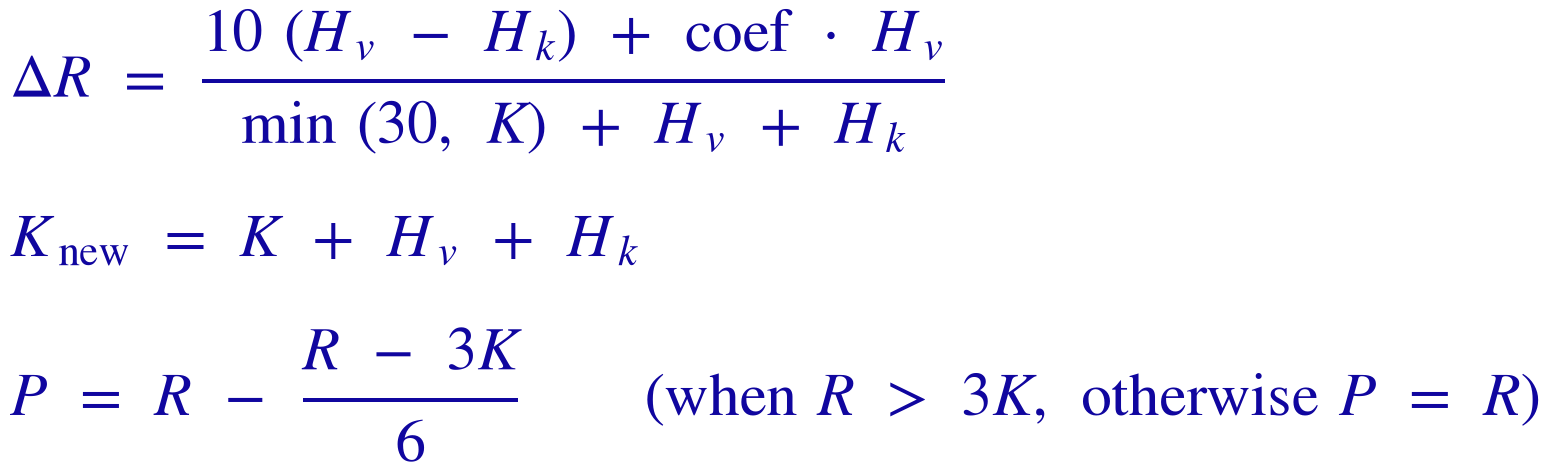 Hv and Hk are the summed values of the wins and losses (below), coef the points coefficient of the event (see Coefficients); the weight K counts as at most 30. P is the placement point score that orders the list. |
|
| Match values | Favourite wins: 2 at a gap of 0–10, 1 at 11–30, 0 above 30. Upset: (gap + 5) ÷ 3 for winner and loser, at most 15. | |
| Weight decay | Every Tuesday: K − K²/900 when K is above 10, otherwise K − 0.08. | |
| Placement points | The list is ordered by the placement points P (third line above), not by the rating, so a player with a low weight (few matches) is placed below the rating. In the combined list a woman is placed at her place × 4.5 plus the number of women ahead of her. | |
| Coefficients | Estonian championships ×1.4, Top 10 ×1.2, Grand Prix ×1.1 (adult events), plus 1–2 extra points for the winner. A walkover costs the absent player 1 point (first walkover only). | |
| Lists | New players get a starting rating from their first event, at most 15. A player drops off the list after 365 days without play but keeps the points. Team competitions use the latest list published at least a month before registration closes. | |
| Source: ELTL reiting, pop-up “Arvutamise metoodika” · ELTL reiting (list) | ||
| ⬆️ | ||
| 4.9. |
FINLANDSPTL · rating manual V8.0 (Aug 2024) |
|
| Formula | Points by rating gap Δ, calculated with the exact gap: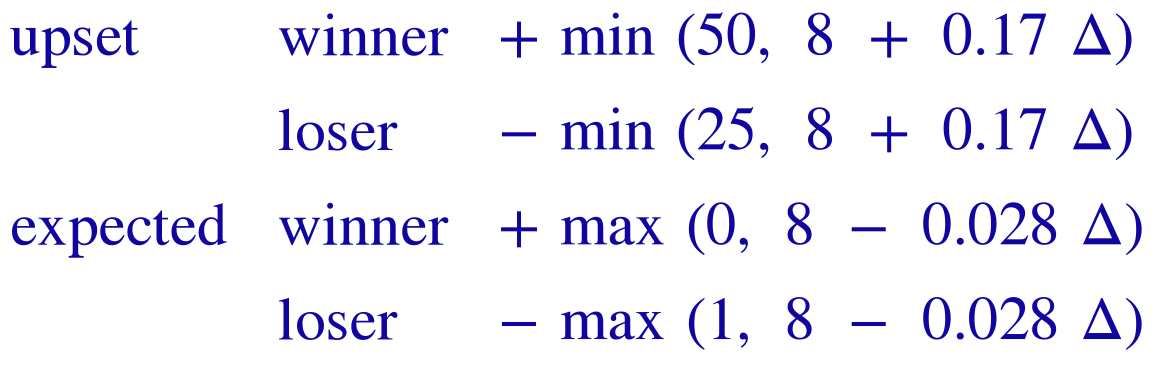 |
|
| Limits | More than 60 points up or down in one day counts only 60 + half the excess. The base rating never drops below 700. | |
| Bonus | Every win adds one bonus point, kept for 12 months; above 50 bonus points only half counts. Seeding uses base rating + bonus. | |
| Leagues | Men: Mestaruussarja, then 1st to 6th division (1-divisioona … 6-divisioona); the lowest levels are played in regional groups. Women: Mestaruussarja, 1st and 2nd division. | |
| Lists | A daily, unofficial “day rating”; the official values are the weekly published lists, used for seeding and eligibility. | |
| Source: SPTL Rating-manuaali V8.0 · SPTL Sarjat | ||
| ⬆️ | ||
| 4.10. |
FRANCEFFTT · points de classement |
|
| How points move | Four outcomes by gap band: normal win, normal loss, upset win (“perf”) and upset loss (“contre”). At equal points the winner gets +6 and the loser −5. A perf across 500+ points is worth +40. | |
| Coefficients | ×2 French senior championships and Pro A / Pro B · ×1.5 Critérium fédéral and French youth championships · ×1.25 finals by class · ×1 national team championship and national A tournaments · ×0.75 other national tournaments · ×0.5 regional and departmental events. | |
| Scale | New players start with at least 500 points, and anyone below 500 is reset to 500 at the end of each phase. Class is the hundreds digit (500–599 = class 5). The top 1000 men and 300 women get a national number instead. Because normal results give more points than they take, all totals are shifted back by the rise of the average at the end of each phase. | |
| Timing | “Points mensuels” are recalculated monthly. The official list is published in July and January and fixes your class for that phase. A player who does not turn up loses the points of a defeat; the opponent gains nothing. | |
| Source: FFTT Règlements généraux 2026–2027, title IV “Le classement” (IV.201–IV.206) · FFTT règlements | ||
| ⬆️ | ||
| 4.11. |
GERMANYDTTB · TTR, andro-Rangliste |
|
| Formula | Calculated once per event over all the player's singles there: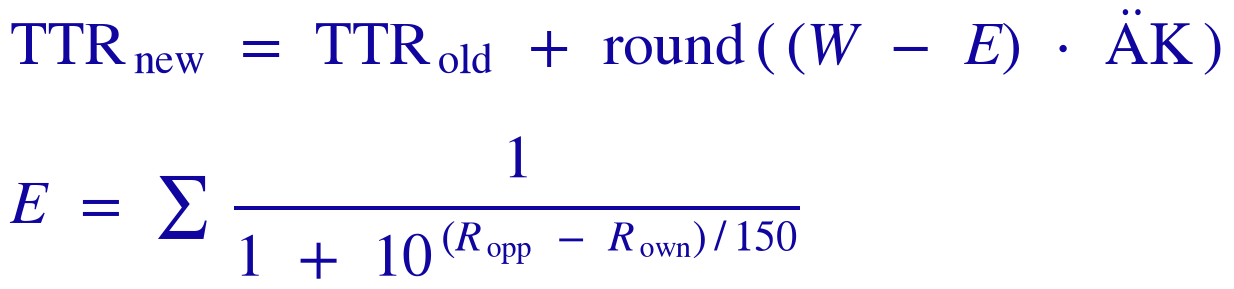 W = wins, E = expected wins (the sum of the winning chances in each single), ÄK = change constant (below). |
|
| Change constant | 16 base, plus 4 for each of: under 21, under 16, fewer than 30 rated singles, first 15 singles after a year without play. Range 16–32, so the winner's gain and the loser's loss can differ. | |
| Youth & inactivity | Players aged 17 and under get +6 every quarter for natural improvement. Adults lose 80 after 24 months without a match, then 20 for each further 6 months, stopping after 3 years. | |
| Official values | Q-TTR is frozen on 11 Feb, 11 May, 11 Aug and 11 Dec. It's used for team line-ups, tournament classes and seeding. The database holds over 61 million singles going back to 2005. | |
| Source: Beschreibung der andro-Rangliste (14 Aug 2025) | ||
| ⬆️ | ||
| 4.12. |
GREECEΕΦΟΕπΑ · evaluation table 2026–27 |
|
| How points move | Two tables by gap, multiplied by the event coefficient. Expected result at coefficient 1: winner +9 (gap 0–25) down to 0 (above 750). Unexpected: +10 (0–24.9) up to +40 (750+). The loser loses 0.3 × the winner's base value. | |
| Coefficients | Winner ×5 / loser ×1.5: national championship final. ×4 / 1.2: A1 league, TOP. ×3 / 0.9: A2 league, regional championships, cup. ×2 / 0.6: B league, open championships. ×1 / 0.3: local leagues. | |
| Bonus | National championship placings add bonus points (men and women: 1st 130, 2nd 105 … participation 15), valid until the end of the next season. | |
| Lists | Monthly; complaints within 48 hours. Seeding uses the table valid on the day of the draw. | |
| Source: ΕΦΟΕπΑ general announcement 2026–27, art. 20 | ||
| ⬆️ | ||
| 4.13. |
HUNGARYMOATSZ · ranglista |
|
| How it works | Placement points from counting events. Singles: national championship 2000 for the winner (1400, 700, 350…), first-class MOATSZ tournament 1500, regional second-class 600, county championship 125, other events 20. Doubles are worth about half and are added in. | |
| What counts | Your best 6 results from the last 12 months, with at most 2 from second-class events. A seeded player who loses in the first round gets half the round's points. A late withdrawal counts as a 0-point event. | |
| Lists | A seeding list in the first week of every month. The official adult list on 30 June sets I and II class grades, and the top 30 are I class. Players in the ITTF top 100 go to the top. | |
| Unofficial Elo | The PONGER platform (in beta) keeps an Elo list using the same exchange chart as the USA. Players start from their level: leisure 1000, county 1 1800, NB I 2300, Extra Liga 2500. | |
| Source: MOATSZ Ranglista szabályzat (Aug 2025) · PONGER Elo list guide (2026) | ||
| ⬆️ | ||
| 4.14. |
IRELANDTable Tennis Ireland · Senior Ranking Scheme (2022–23, version 3.9, the latest found online) |
|
| How points move | Match points for every match by the gap in ranking points. Expected win +4 at 0–20 down to +1 above 70, expected loss −2 down to −0.5; upset win +4 up to +10, upset loss −2 down to −5. | |
| Tournament factor | ×1.5 Senior Championships, Senior Classification and Top 10/12; ×1.25 the four provincial Opens; ×1 the National Team Tournament (Premier, 1st and 2nd division) and other events. | |
| Placing points | Added for the finishing place in main events: winner 40 / 30 / 24 by tournament grade, down to 10 / 6 / 5 for all others; per tournament only the best event counts. | |
| World ranking | Movement on the ITTF world ranking since the previous Irish event is added: 40% of gains, 15% of losses. | |
| Season | Each season starts at 50% of the previous season's final points; players without an Irish ranking event in the previous season are removed. New players start at 0, and the match points of their first event become their starting points before those matches are recalculated. | |
| Lists | By category and season. The senior men's leader had 206 points; junior lists use another scale (U13 leader 3000). | |
| Source: TTI Senior Ranking Scheme 2022/2023, version 3.9 · TTI rankings | ||
| ⬆️ | ||
| 4.15. |
ITALYFITeT · classifica 2026–27 |
|
| How it works | Since 2025–26 an ITTF-style “objective method” has replaced the EloTT rating (2017–2025), which had replaced the older Esox system. A defeat never costs points. One national list covers national, regional and para events. | |
| Points from | Season start value + league wins (base points by division, plus a bonus for beating a higher-ranked player) + tournament placings (best results per tournament type) + group-stage wins (20 at national events, 15 at Opens, 10 or 5 at regional events). | |
| Categories | Set on 1 July for the whole season. Men: 1st cat. top 12 · 2nd 108 · 3rd 332 · 4th 1548 · 5th 3000 · 6th from 5001. Women: 8 · 42 · 148 · 202 · 5th from 401. | |
| Start & reset | Each July all points are rescaled so the top Italian has 13,000 and the last has 100. New players start on 100 provisional points; A1 imports start at 12,200–13,500 by world ranking, A2 at 11,300, B at 8,700, C1 at 7,000. Italians in the ITTF top 300 get protection points on top. Inactive players drop to “fuori quadro” with −5%. | |
| Source: FITeT Regolamento Classifica Individuale 2026/2027 (the per-round points tables are in a separate technical annex) | ||
| ⬆️ | ||
| 4.16. |
LATVIALGTF · reitings, rating regulation amended 31 Jul 2025 |
|
| How points move | Two points tables by rating gap. Expected result: +9/−8 at a gap of 1–25, down to +1/0 above 500. Upset: +10/−9 at 0–24, rising to +32/−25 at 500 and more. | |
| Coefficients | ×0.25 to ×4 by event: national championship final ×3, its groups ×2, qualification ×1; team championship top league ×2, 2nd league ×1.5, 3rd and lower leagues ×1; youth events ×0.25–1. Up to ×1 both players' points are multiplied; from ×1.5 only the winner's, the loser pays ×1. | |
| Bonus | Points for the first 8 places of an individual event (winner 40 at ×1, up to 160 at ×4), valid one year; only the 10 best bonuses count. Bonus points are not used when match points are calculated. | |
| Lists | Monthly, published by the 10th (official since 1 September 2012). New players start at 1, or after wins over players rated above 200 at most the rating of the weakest player they lost to. After 24 months without play a player is removed but keeps the points. | |
| Source: LGTF Reitinga nolikums (amended 31 Jul 2025) · LGTF | ||
| ⬆️ | ||
| 4.17. |
LITHUANIALSTA · reitingas |
|
| How points move | Points per match from a table by gap (annex 4, not readable online). The 2012 example: an upset at 0–24 gives +10 to the winner and −5 to the loser. All matches of an event use the ratings at its start. | |
| Coefficients | National championship stage II ×3; stage I ×1.5; TOP-12, LSTA cup, top league ×2; 1st–4th league ×1.5 / 1.4 / 1.3 / 1.2; commercial tournaments ×0.5–1. | |
| Lists | Monthly on the 1st. New players enter after their first rated event; after 24 months without play a player is removed but keeps the points. | |
| Source: LSTA rating rules (30 Sep 2021) | ||
| ⬆️ | ||
| 4.18. |
LUXEMBOURGFLTT · performance system and classes |
|
| Two systems | Every licensed player has a performance value (PFW), which sets the federation ranking list (VB-RGL), and a class: A1–A3, B1–B3, C1–C3, D1–D3. Recreational players are “NC”. The PFW calculation is in an internal regulation that isn't published; in August 2026 the leader had about 1050 and number 100 about 550. | |
| Classes A and B | A1 = places 1–20 and A2 = places 21–60 of each new ranking list. B3, B2, B1 and A3 follow from PFW thresholds in a table that is reviewed every season. | |
| Classes C and D | Move by plus and minus points: a win against the same class earns ½, and each class higher adds another ½. 12 plus points move you up a class, 6 minus points move you down (from 1 July 2025). Beginners start in D2 (adults) or D3 (youth). | |
| What counts | All team-championship singles, the national and regional championships, the Kriterium and club tournaments. Doubles don't count. | |
| Source: FLTT Reglemente (16 Sep 2025), art. 5.7.101–106 · FLTT ranking system | ||
| ⬆️ | ||
| 4.19. |
NORWAYNBTF · ranking |
|
| How points move | Table by gap. Expected result: +8/−7 at equal points, down to +1/−1 above 600. Unexpected: ±8 at 1–49, rising to ±25 above 600. | |
| Weights | ×2 national championships (elite) and senior national circuit; ×1.5 age-group championships and the top league; ×1 other tournaments and leagues. | |
| Leagues | STIGA-Ligaen (men and women; called Eliteserien until 2011/12 for men and 2022/23 for women), then 1., 2. and 3. divisjon nationally and 4. and 5. divisjon in the regions. | |
| Classes | Men: Elite ≥2600 · A 2300 · B 2000 · C 1700 · D 1400 · E 1050 · F below. Women: Elite ≥1800 · A 1500 · B 1200 · C below. | |
| Lists | Normally published on the 1st of each month. International tournaments in Norway do not count. | |
| Source: NBTF “Om rankingen” · NBTF Seriespill · STIGA-Ligaen (Wikipedia) | ||
| ⬆️ | ||
| 4.20. |
POLANDPZTS · OLR |
|
| How it works | National ranking lists (OLR) by age category, built from singles placings at Grand Prix Polski (GPP) and the Polish Championships (MP). | |
| Points | Senior MP: 1st 400, 2nd 352, 3rd–4th 284, 5th–8th 229. Senior GPP: 1st 300, 2nd 274. Seniors count the best 2 of the last 3 tournament series (rolling); other ages count the best 3 of the season. | |
| League play | The PZTS rules describe no per-match rating for league matches. League results don't feed the national list. | |
| Source: Regulamin rozgrywek PZTS 2025/2026, §14 and §18 | ||
| ⬆️ | ||
| 4.21. |
PORTUGALFPTM · Classificação Nacional |
|
| Tournaments | Placement points by tier: Open 1250 / 800 / 500 / 300 / 100. The winner gets the tier value (1250, 800…), down to the last 16 or 32. Only the best 5 Open results count. | |
| Senior leagues | Only won singles count: (fixed 30–120 by division and phase + 20–400 by the opponent's national rank) × coefficient 0.40–1.00. Beating a top-4 player is worth 400 variable points. | |
| Quirks | Resets to 0 every season. The national senior championship does not count. Not turning up in a main draw costs 100 points. | |
| Source: Regulamento das Competições Desportivas, from 1 Aug 2026, ch. 4 | ||
| ⬆️ | ||
| 4.22. |
ROMANIAFRTM · clasament individual |
|
| How it works | A monthly list of accumulated points from the national team championship (first and second half, play-off and play-out) and the national individual championships of this and the previous season. In October 2026 the leader had 314 points. | |
| Use | The list sets seeding and group placement at national events; players without points are drawn by lot. The world ranking (top 200) comes first for seniors. | |
| Gaps | The FRTM regulations don't publish how many points each result is worth. | |
| Source: FRTM rankings · national individual championship rules 2026 | ||
| ⬆️ | ||
| 4.23. |
SCOTLANDTable Tennis Scotland · Ratings Central |
|
| Model | Since 24 March 2026 the ranking is powered by Ratings Central (Bayesian, as in Austria). Players are ordered by rating; equal ratings are split by the lower rating deviation. | |
| Lists | Full list, rating list (active in the last 12 months) and ranking list (eligible for Scotland). Ranked only with a rating deviation of 150 or less. Official lists are recalculated only after national events. | |
| Before 2026 | A points system with Table Tennis 365: points per match, season August–July, 10% reduction every 1 August. | |
| Source: TTS new ranking system | ||
| ⬆️ | ||
| 4.24. |
SERBIASTSS · ranking rules of 20 May 2025 |
|
| How it works | Placement points at counted individual events. National championship: 1st 375, 2nd 293, semi-final 199, quarter-final 123, last 16 76, last 32 47, last 64 29, a group win 18. TOP-12: 325 down to 72 for 12th. Ranking tournaments: 1st 250, 2nd 200 … last 64 15, group win 5. New Year tournament (youth): 1st 300 … | |
| What counts | Seniors (from 2026): national championship, TOP-12 and four ranking tournaments; the best 5 count, and points are kept for one year (as in the ITTF ranking). Youth: championship, TOP-12, three ranking tournaments and the New Year tournament; best 5. The previous season's youth points are deleted after the second ranking tournament. | |
| Lists | Current lists after every counted event. Final lists: youth by 1 July, seniors on 31 December. Players in the ITTF top 400 (seniors) and ETTU top 20 (juniors, cadets) are listed first; for the final senior list they must also play the championship, TOP-12 and at least two ranking tournaments. | |
| Leagues | Super liga, 1st and 2nd league, regional and zone leagues; each league also keeps its own players' list (win record). | |
| Source: STSS ranking rules (20 May 2025) · STSS ranking lists | ||
| ⬆️ | ||
| 4.25. |
SLOVAKIASSTZ · rebríček |
|
| Formula | League win percentage plus bonuses: League bonus: Extraliga +100, 1st league +50, regional 2nd league 0, county 2nd league −10. Foreign leagues are included, for example Bundesliga positions 1–2 at +205. |
|
| Bonuses | Slovak championships: 1st place 30 (24, 18, 12…). Slovak Cup tournaments: up to 9. Extraliga play-offs multiply the win–loss difference by 1–3. ITTF top 50: +40, down to +7 for ranks 201–300. | |
| Rules | You need 40% of your league matches and at least 50 points to be listed. Lists come out on 1 January and 30 June. Missing a half-season costs 5%. The ITTF top 150 are listed in world-ranking order. | |
| Source: SSTZ Pravidlá pre tvorbu slovenských rebríčkov (in force from 1 July 2023; the latest version published) · current men's list | ||
| ⬆️ | ||
| 4.26. |
SLOVENIANTZS · jakostna lestvica |
|
| How it works | Placement points: national championship 2000 for the winner (1600, 1300, 1000…), Masters and TOP tournaments 1700, open tournaments 1300. Every individual win in the national leagues adds points: 1st SNTL 75, 2nd 25, 3rd 10, 4th 5 (seniors only). | |
| What counts | A running season total in each category, minus the worst result. Before each national championship the previous season's points still count for events not yet played. | |
| Lists | Published after every counting event. The final list at the end of the season puts the ITTF top 250 men and top 200 women first, in world-ranking order. | |
| Separate list | Recreational and veteran players have their own placement list by age group. | |
| Source: NTZS Pravilnik o sistemu tekmovanj V4.6 (June 2026), art. 25–30 · rankings | ||
| ⬆️ | ||
| 4.27. |
SPAINRFETM · Glicko |
|
| Model | Glicko with c = 50, RD between 50 and 350. Each player has a rating and a “rating deviation” showing how reliable it is. Active players' ratings move little; returning players' ratings move fast. | |
| Lists | One men's and one women's list for all ages, from juniors to veterans, updated on the 1st of each month with 72 hours for complaints. 12+ matches in 12 months are needed to appear. | |
| New players | Start by age or league: benjamín 900, alevín 1050, infantil 1200, senior 1400. By league: Primera 1650, División de Honor 2125, Superdivisión 2450. | |
| 2025–26 | Every rating was rescaled once: The youngest categories also have a separate placement ranking. |
|
| Source: RFETM circular 15, 2025/2026 | ||
| ⬆️ | ||
| 4.28. |
SWEDENSBTF · dataranking 2026–27 |
|
| How points move | Zero-sum table: what the winner gains, the loser loses. At a gap of 0–25 it's ±10. A favourite winning with a gap over 300 gets +2; an upset across 500+ is ±40. At SM, RM and DM championships the winner's points are multiplied by 1.5. | |
| Limits | Calculated once a month, with a maximum change of ±250. Players on 300 or below don't drop. A match against an unlicensed foreign player is a flat ±5. The world top 200 are listed first, in world-ranking order. | |
| Normalisation | Every 1 July all ratings are recalculated to fit 0–2500, keeping everyone's order but undoing points inflation (since 2024–25). | |
| New players | Average of the opponents in the 2 best wins and 2 worst losses. Defaults when two new players meet: men 1000, women 800, boys 15 900, girls 15 700, and down by age. | |
| Source: Manual för dataranking 2026–2027 | ||
| ⬆️ | ||
| 4.29. |
SWITZERLANDSwiss Table Tennis · Elo |
|
| Classes | D1–D5, C6–C10, B11–B15 and A16–A20 are set from Elo points. The 2025 reform added A21 (A20 minimum + 100) and A22 (+200, or world top 100). | |
| 2025 reform | Tournament bonus points for reaching finals were abolished. At most 100 Swiss men are graded A. An unexcused no-show costs 20 Elo. The scale from D1 to B15 is unchanged. | |
| New players | 600 Elo, class D1. Lists are published monthly on click-tt. | |
| Source: swisstabletennis.ch Elo reform (the exact points table is not on that page) | ||
| ⬆️ | ||
| 4.30. |
TURKEYTürkiye Masa Tenisi Federasyonu · league player rankings |
|
| League ranking | Player rankings for the Süper Lig and the 1st, 2nd and 3rd League, men and women: ranking points = league coefficient × win points. Coefficients: Süper Lig ×5, 1. Lig ×4, 2. Lig ×3, 3. Lig ×2. A win against the opponent's A or Y player gives 3 points, against B or X 2, against C or Z 1; a loss 0. | |
| What counts | For 2024–25: the first half of the season, the play-offs and the classification matches; compiled by the TMTF Technical Board. | |
| Tournaments | The 2025–26 season booklet says rankings follow ITTF rules and gives placement points for national team trials and the Turkish championship (1st 32, 2nd 31, …). | |
| Other | An independent site (TT-Rating) runs a rating, but it is not the federation's. | |
| Source: TMTF: 2024–25 league player rankings announced · TMTF season booklet 2025–26 | ||
| ⬆️ | ||
| 4.31. |
UKRAINEUTTF · rating and weight |
|
| Model | Each player has a rating R and a weight N (how stable the rating is). After a tournament: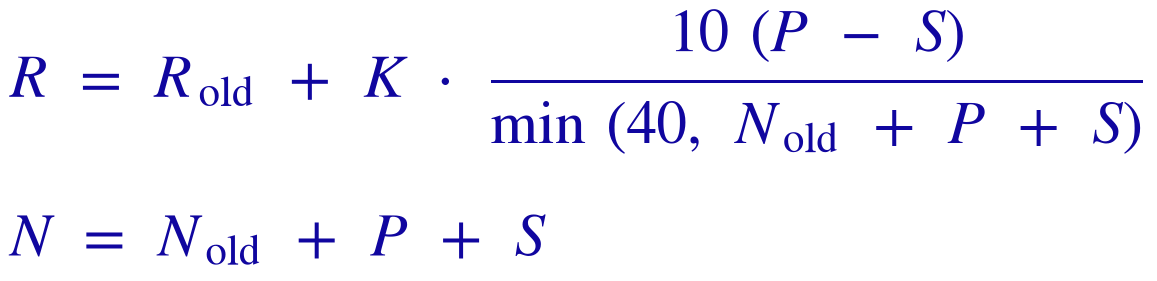 P and S are the sums of the match values for wins and for losses (below); K is the event coefficient. The divisor is capped at 40. Estonia uses the same model (🇪🇪4.8). |
|
| Match values | Favourite wins: 2 if the gap is ≤2, 1 if it is 3–20, 0 above 20. Upset: (gap + 5) / 3 for winner and loser. | |
| Weight decay | On the 1st of every month every weight drops by N²/300; a player is removed when the weight or the seeding rating reaches 0. With weight below 12 the “rating with penalty” used for seeding is lowered. | |
| Scale | The average of the top 100 men (and separately women) is held at 60 by a correction every half year. A woman's rating converts to the men's scale at ×0.75 (60 → 45). | |
| Source: UTTF ranking rules (15 Nov 2025) | ||
| ⬆️ | ||
| 4.32. |
USAUSATT · rating |
|
| How points move | Zero-sum exchange chart: at a gap of 0–12, ±8. A favourite winning with a 238+ gap gets 0. An upset across 238+ is worth 50. | |
| Passes | Pass 1 raises underrated players: a gain of 60+, or 40+ with two 20-point wins. Bigger jumps trigger a “special adjustment” based on the ratings they beat. Pass 2 rates newcomers, and the final pass applies the chart. | |
| Leagues | The same rules produce a separate USATT League rating. | |
| Source: USATT Ratings System Explained (7 Aug 2025) | ||
| ⬆️ | ||
| 4.33. |
WALESTable Tennis Wales · Ranking System Guide (version 12, December 2025) |
|
| How it works | Points for every win, nothing lost for a defeat. The value of a win depends on the league division or the tournament stage, not on the opponent. Team Championships of Wales: 20 points per win in the Premier Division, then 16, 14, 12, 10, 8, 6, 4 and 2 in Divisions 1–8. Team opens: 6 per singles win, 2 per doubles win. | |
| Individual events | Open events: 4 for a group win, then 8, 16, 24, 32 and 40 for wins up to the final; elite opens and Grand Prix events double that; bands get less. Welsh National Championships: 16 for a group win up to 160 for winning the final. Group events: 2–16 per win by band. | |
| Representing Wales | A bonus of 260 points (Olympic Games, World Championships) down to 60 (other selected events), plus a tenth of that for every win. | |
| Lists | Monthly, on the first Friday, for each gender and age group (senior, U21, junior, cadet, U13, U11, veterans, over 50/60/70); season 1 September to 31 August, plus a separate list for the Dragon events. All points are cut by 20% at the end of the season. Players in the WTT top 500 (seniors) or the ETTU top 100 (youth) keep a protected ranking. | |
| Source: TTW Ranking System Guide, version 12 (Dec 2025) · TTW how the ranking works | ||
| ⬆️ | ||
| 4.34. |
ETTUETTU · European ranking rulebook 2026 |
|
| How it works | Points per event: At weight 1.0 the winner gets 2000, the runner-up 1750; each win adds victory points by the opponent's European rank: 1–2 = 150, 3–4 = 125, 5–8 = 100, 9–16 = 75, 17–32 = 50, 33–64 = 25, 65–100 = 20, down to 1 above 500. |
|
| Weights | 2.0 the monthly world-ranking extract (seniors; 1.5 for youth); 1.0 European and World Championships, Olympic Games; 0.8 Europe Top 16 Cup, Europe Youth Top 10; 0.6 Europe Youth Series; 0.4 European U21 Championships; 0.2 / 0.1 / 0.05 sanctioned international, regional and U21 events. | |
| World ranking | Each month the European players on the ITTF list are treated as a virtual knockout event at weight 2.0: the highest-ranked European gets the winner's points, the next the runner-up's, and so on. These points last one month. | |
| What counts | Best 4 results (men, women, U15, U13), best 3 (U19). Team matches (European Championships, Champions League, Europe Cup and Trophy) give victory points. Points last until the next edition of the event, e.g. about two years for the European Championships. | |
| Lists | Men, women (U21 extracted), U19, U15 and U13, published on the first Friday of each month after the ITTF list of that Monday. | |
| Team ranking | Men's and women's national teams, published monthly. Points = weight × final-position points + victory points for each team-match win (by the opponent's European team rank), plus monthly points for the association's place when the European-ranking points of its best 3 players are added up. The best 3 results count; European Team Championships points last about two years. | |
| Mixed-team ranking | Used for European Games qualification. Each association adds up seven places: its best man and best woman in the European singles rankings, its men's and women's team ranking positions, and its best men's, women's and mixed doubles placings at the latest European Championships. The lowest total ranks first. | |
| Source: ETTU ranking documents · European Individual Ranking Rulebook 2026 · final position points table · victory points table · current ranking · European Teams Ranking Rulebook · European Mixed Team Ranking (27 Jul 2026) | ||
| ⬆️ | ||
| 4.35. |
ITTFITTF · Table Tennis World Ranking Regulations (8 Oct 2026) |
|
| How it works | Points for the round reached in the main draw or in qualifying, plus extra points for qualifiers who reach the main draw. A player's total is the sum of the best 8 results that have not expired, with at most one continental or regional result and at most four youth results. Points are valid for one year. | |
| Winner's points | Olympic Games, WTT Grand Smash and World Championships 2000; WTT Finals and World Cup 1500; WTT Champions 1000; WTT Star Contender 600; continental championships, games and cups 500; WTT Contender 400; WTT Feeder 125; Commonwealth and Pacific Games 100; U19 Youth Grand Smash and World Youth Championships 50; U21 continental championships 20; U19 Youth Contender 10. | |
| Teams | Points for the round a team reaches are split between its players by their share of the team's wins (at least 10%, at most 70%). | |
| Lists | Published weekly on Monday: singles and doubles for seniors, used for entries and seeding at ITTF and WTT events. | |
| Youth ranking | One under-19 list, also shown as U17, U15, U13 and U11; weekly on Monday. The best 10 results count (at most one continental), each valid for one year. | |
| Team ranking | Senior men's, women's and mixed teams, U19 and U15 teams; published on the first Monday of each month. A men's or women's team scores its best 3 team results (at most one continental), plus monthly points for its association's place when the world-ranking points of its best 3 players are added up. Team points last until the next edition of the event (at most four years). | |
| Para ranking | Wheelchair (classes 1–5), standing (6–10) and intellectual impairment (11), with an under-23 filter; weekly. The best 6 results count (at most one continental, at most two under-23), each valid for one year. | |
| Protection | Players who are injured, ill or pregnant for 6–18 months can keep their points for entry and seeding in their first 3–5 events after returning. | |
| Source: ITTF rankings page, with the World, Youth and World Team Ranking Regulations (8 Oct 2026) and the World Para Ranking Regulations (7 Oct 2026) · ITTF announcement (6 Jan 2026) | ||
| ⬆️ | ||
| 5. |
HOW TO READ THE NUMBERS |
| 5.1. | Ratings can't be compared between countries. Each system has its own scale, starting values, player pool and amount of inflation. Germany's 150-point formula, Sweden's yearly reset and France's 500 floor mean that the same number reflects a different level of play in each country. |
| 5.2. | Not covered: the other European federations weren't checked. Croatia's placement table and Romania's point scale aren't published in readable form. The Swiss and Danish tables weren't fully available online. |
| 6. |
ESTIMATE EQUIVALENCE TABLES – MEN AND WOMEN |
| 6.1. | A successor to the Belgian Vergelijkingstabel / Tableau d'équivalence of 2010–11, with the Dutch senior licence as the reference. Each row is one NTTB licence with its Elo range (men A–H, women A–E); each column shows the league a player of that level typically plays in and, where the country has one, the matching class or rating. Countries are in the same order as section 4. Of the countries added last, only Finland, Greece, Latvia, Lithuania, Norway, Serbia, Turkey and Wales publish classes or a league order that can be placed (Lithuania and Wales for men only); Estonia, Ireland, Scotland, Ukraine and the USA (no league ladder) are left out. An empty cell continues the entry above it. |
| 6.2. | ◆ marks leagues placed with published coefficients. The Czech federation values foreign leagues against Czech Extraliga = 100 (Bundesliga 138, Polish 1st league 106.8, 2. Bundesliga 104.6, Austrian 1st league 97, Italian 1st league 92.2, 3. Liga 89.4, Regionalliga 76, Czech 1st league 71.8, Oberliga 63.6, Czech 2nd league 56.4, Verbandsliga 54). The Slovak federation adds a league bonus to the win percentage (Bundesliga +205, French Pro A +190, Polish Superliga +165, Italian Serie A +150, Czech Extraliga and Austrian 1st Bundesliga +140, French Pro B +135, Slovak Extraliga +100, Regionalliga +95, Czech 1st league and Austrian 2nd Bundesliga +90, Oberliga +65, Slovak 1st league +50, Verbandsliga +45). |
| 6.3. | The licence thresholds and the class and rating values are the federations' own (NTTB licences, Belgian classement, French classes, Swiss, Swedish, Danish, Italian and Luxembourg classes, Spanish Glicko start values per league, Hungarian PONGER start values per league, Croatian rating categories). The Dutch column is measured: is the average NTTB Elo of the players in each class (NTTB class strength, autumn 2026, ratings of 1 July 2026); regional classes are mixed (men and women) and numbered differently in each region. In the Netherlands women have only two leagues of their own, the Eredivisie and the 1e divisie; all other women play in the men's competition, at any level from the Eredivisie down to the lowest class, so the women's table shows only these two leagues. In the other columns, where a value sits in the table, and every league without ◆, is an estimate in the spirit of the 2010–11 table. Austrian and English ratings are not shown because no published band per league exists. For the German 1. Bundesliga the Q-TTR range of the players on 👉ttbl.de is shown (October 2026); the other German leagues have no published TTR band. |
| 6.4. | For women the Slovak federation gives separate league bonuses (Bundesliga +215, French Pro A +195, 2. Bundesliga +185, Polish Superliga +165, Italian Serie A +160, Czech Extraliga +155, Austrian 1st Bundesliga +150, 3. Bundesliga +145, Slovak Extraliga, Italian Serie B, Czech 1st league and Austrian 2nd Bundesliga +100, Regionalliga +85); these place the ◆ leagues in the women's table. The Czech coefficients cover men only. Hungarian PONGER start values are not shown for women because they are not set per gender. |
| 6.5. |
MEN |
| NTTB licence · Elo |
NED Netherlands |
AUT Austria |
BEL Belgium |
CRO Croatia |
CZE Czechia |
DEN Denmark |
ENG England |
FIN Finland |
FRA France |
GER Germany |
GRE Greece |
HUN Hungary |
ITA Italy |
LAT Latvia |
LTU Lithuania |
LUX Luxembourg |
NOR Norway |
POL Poland |
POR Portugal |
ROU Romania |
SRB Serbia |
SVK Slovakia |
SLO Slovenia |
ESP Spain |
SWE Sweden |
SUI Switzerland |
TUR Turkey |
WAL Wales |
|---|---|---|---|---|---|---|---|---|---|---|---|---|---|---|---|---|---|---|---|---|---|---|---|---|---|---|---|---|
| A | Eredivisie Elo 2345 |
◆ 1. Bundesliga | A |
cat. I–IV (top 16) |
◆ Extraliga coef. 100 |
Elite ≥2400 |
Senior BCL Premier | Mestaruussarja | ◆ Pro A · Pro B N° 1–200 |
◆ Bundesliga (TTBL) · 2. Bundesliga · 3. Bundesliga TTR 2190–2570 (1. Bundesliga, middle 80% of 71 players, Oct 2026) |
Extra Liga 2500 · I. class (top 30) |
◆ Serie A1 1ª cat. (top 12) |
NL 1 A1 (top 20) |
STIGA-Ligaen Elite ≥2600 |
◆ Superliga | Superdivisión start 2450 |
Pingisligan Elit ≥2250 |
NLA A20–A22 |
||||||||||
| A ≥2160
|
◆ 2. Bundesliga · Landesliga | B0–B2 |
Superliga · 1. HSTL cat. V–VI (17–64) |
◆ 1. liga · ◆ 2. liga 71.8 · 56.4 |
kl. 1 2100–2399 |
BCL Championship · lower divisions | 1-divisioona | Nationale 1–2 N° 201–1000, ≥1900 pts |
◆ Regionalliga · ◆ Oberliga | A1 league (×4) | NB I 2300 |
Serie A2 · B1 2ª–3ª cat. (13–452) |
NL 1 A1–A2 (21–60) |
1. divisjon A 2300–2599 |
I liga · II liga | 1.ª Divisão · Divisão de Honra | Superliga · Divizia A | Super liga | ◆ Extraliga · ◆ 1. liga bonus +100 · +50 |
1. SNTL | División de Honor start 2125 |
Superettan · Division 1 Elit, Kl. 1 2000–2249 |
NLB A16–A19 |
Süper Lig (×5) | ||||
| B 1960–2159
|
1e divisie Elo 2092 |
Landesliga · 1. Klasse | B4–C0 |
2. HL cat. VII (65+) |
3. liga · divize · krajský přebor | kl. 2–3 1700–2099 |
local league Premier | 2-divisioona | Nationale 3 · Pré-nationale · Régionale 1 1500–1899 (cl. 15–18) |
◆ Verbandsliga · Landesliga · Bezirksoberliga | A2 league (×3) | NB II · NB III 2000–2150 |
Serie B2 · C1 · C2 3ª–4ª cat. |
Augstākā līga (×2) | top league (×2) | NL 2–3 · Division 1 A3, B1–B2 |
2. divisjon B 2000–2299 |
II liga · III liga | 2.ª Divisão | Divizia B | 1. liga | ◆ 2. liga (regional, county) · lower regional leagues 0 · −10 |
2. SNTL · 3. SNTL | Primera División start 1650 |
Division 1–2 Kl. 1–2 1750–2249 |
1. Liga · 2. Liga B11–B15, C10 |
1. Lig (×4) | Premier Division (20 per win) |
| C 1760–1959
|
2e divisie Elo 1926 |
1. Klasse | C2 |
3. HL | krajský přebor | kl. 4 1500–1699 |
local Division 1 | 3-divisioona | Régionale 2 1400–1499 (cl. 14) |
Bezirksliga | B league (×2) | NB III 2000 |
Serie D1 4ª cat. (453–2000) |
2. līga (×1.5) | 1st league (×1.5) | Division 1 B2 |
3. divisjon C 1700–1999 |
IV liga | district leagues | county leagues | 2. liga | lower regional leagues | 3. SNTL | Segunda División start 1400 |
Division 3 Kl. 3 1500–1749 |
2. Liga C8–C9 |
2. Lig (×3) | Division 1 (16) |
| D 1460–1759
|
3e divisie · regional top Elo 1757 · 1450–1640 |
2. Klasse | C4–C6 |
county leagues | krajská soutěž | kl. 4–5 1300–1699 |
local Division 2 | 4-divisioona | Régionale 3 · Départementale 1 1200–1399 (cl. 12–13) |
Bezirksklasse · Kreisliga | local leagues (×1) | Megye I 1800 |
Serie D1 · D2 5ª cat. (2001–5000) |
3. līga and lower (×1) | 2nd league (×1.4) | Division 2 B3, C1 |
4. divisjon D 1400–1699 |
IV liga · V liga | regional leagues | 4. SNTL | Division 3–4 Kl. 3–4 1250–1749 |
3. Liga C6–C7, D5 |
3. Lig (×2) | Division 2 (14) | ||||
| E 1260–1459
|
regional 1st–2nd level Elo 1300–1470 |
3. Klasse | D0 |
okresní přebor | kl. 5 1300–1499 |
5-divisioona | Départementale 1 1100–1199 (cl. 11) |
1. Kreisklasse | Megye II 1600 |
Serie D2 5ª cat. |
3rd league (×1.3) | Division 3 C1–C2 |
5. divisjon E 1050–1399 |
V liga | zone leagues | regional | Autonómica | Division 4 Kl. 4 1250–1499 |
4. Liga D4 |
Division 3 (12) | ||||||||
| F 1060–1259
|
regional 2nd–3rd level Elo 1120–1260 |
3.–4. Klasse | D2–D4 |
okresní přebor · okresní soutěž | kl. 6 1100–1299 |
local Division 3 | 6-divisioona | Départementale 2 950–1099 (cl. 9–10) |
2. Kreisklasse | Megye II–III 1300–1600 |
Serie D3 6ª cat. (5001+) |
4th league (×1.2) | Division 3–4 C2–C3 |
F ≤1050 |
klasa okręgowa · klasa A | Division 5 Kl. 5 1000–1249 |
4.–5. Liga D2–D3 |
Division 4 (10) | ||||||||||
| G 760–1059
|
regional 4th–5th level Elo 790–1060 |
4. Klasse | D6 |
okresní soutěž | kl. 7 <1100 |
local Division 4 | Départementale 3 900–949 (cl. 9) |
2.–3. Kreisklasse | Megye III 1300–1500 |
Division 4 C3–D1 |
klasa A | Division 6 Kl. 6 750–999 |
5. Liga D1–D2 |
Division 5 (8) | ||||||||||||||
| H <760
|
regional 6th–7th level Elo 560–760 |
beginners | E0–E6, NC |
lowest local divisions | Départementale 3–4 500–899 (cl. 5–8) |
3. Kreisklasse and lower | leisure 1000–1100 |
Division 5–6 D1–D3 (start D2 adults, D3 youth) |
klasa B | Provincial | Division 6 Kl. 6–7 ≤999 |
D1 (start 600) |
Divisions 6–8 (6, 4, 2) |
| 6.6. |
WOMEN |
| NTTB licence · Elo |
NED Netherlands |
AUT Austria |
BEL Belgium |
CRO Croatia |
CZE Czechia |
DEN Denmark |
ENG England |
FIN Finland |
FRA France |
GER Germany |
GRE Greece |
HUN Hungary |
ITA Italy |
LAT Latvia |
LUX Luxembourg |
NOR Norway |
POL Poland |
POR Portugal |
ROU Romania |
SRB Serbia |
SVK Slovakia |
SLO Slovenia |
ESP Spain |
SWE Sweden |
SUI Switzerland |
TUR Turkey |
|---|---|---|---|---|---|---|---|---|---|---|---|---|---|---|---|---|---|---|---|---|---|---|---|---|---|---|
| ◆ 1. Bundesliga | A |
cat. I–IV (top 16) |
◆ Extraliga | Elite ≥1750 |
Women's BCL Premier | Mestaruussarja | ◆ Pro A · Nationale 1 numbered (top 300), >1800 pts |
◆ 1. Bundesliga · 2. Bundesliga · 3. Bundesliga | Extra Liga I. class (top 30) |
◆ Serie A1 1ª cat. (top 8) |
women's championship A1–A3 |
STIGA-Ligaen Elite ≥1800 |
◆ Superliga | Superdivisión start 2450 |
Pingisligan Elit ≥1750 |
NLA A19–A22 |
||||||||||
| A ≥1760
|
Eredivisie Elo 1823 |
◆ 2. Bundesliga | B0–B4 |
Superliga cat. V (17–32) |
◆ 1. liga | kl. 1 1500–1749 |
Women's BCL lower divisions | 1-divisioona | Nationale 2–3 1300–1799 (cl. 13–17) |
◆ Regionalliga · Oberliga · Verbandsliga | A1 league (×4) | NB I | Serie A2 · ◆ Serie B 2ª cat. (9–50) |
B1–B2 |
A 1500–1799 |
I liga | 1.ª Divisão (group A) | Superliga | Super liga | ◆ Extraliga bonus +100 |
1. SNTL | División de Honor start 1800 |
Kl. 1 1500–1749 |
NLB A16–A18, B15 |
Süper Lig (×5) | |
| B 1460–1759
|
Landesliga | B6–C0 |
1. HSTL cat. VI (33–64) |
2. liga | kl. 2 1250–1499 |
local league Premier | 2-divisioona | Pré-nationale · Régionale 1100–1299 (cl. 11–12) |
Landesliga · Bezirksliga | A2 league (×3) | NB II | regional leagues 3ª cat. (51–198) |
Augstākā līga (×2) | B3, C1 |
B 1200–1499 |
II liga | 1.ª Divisão (group B) | Divizia A | 1. liga | ◆ 1. liga +50 |
2. SNTL | Primera División | Kl. 2 1250–1499 |
1. Liga B12–B14 |
1. Lig (×4) | |
| C 1260–1459
|
lower classes | C2–C4 |
cat. VII (65+) |
regional leagues | kl. 3 1100–1249 |
local Division 1–2 | Régionale · Départementale 950–1099 (cl. 9–10) |
Bezirksklasse · Kreisliga | B league (×2) | Megye I | 4ª cat. (199–400) |
2. līga (×1.5) | C1–C2 |
C <1200 |
II–III liga | district leagues | Divizia B | regional leagues | regional | Kl. 3 1000–1249 |
2. Liga B11–C9 |
2. Lig (×3) | ||||
| D 1060–1259
|
1e divisie Elo 1145 |
C6–D0 |
county leagues | kl. 4 1000–1099 |
local Division 2–3 | Départementale 850–949 (cl. 8–9) |
Kreisliga · Kreisklasse | local leagues (×1) | Megye II | 5ª cat. (401+) |
3. līga and lower (×1) | C2–C3 |
III liga | county leagues | Segunda División · Autonómica | Kl. 4 750–999 |
3. Liga C6–C8, D4–D5 |
3. Lig (×2) | ||||||||
| E 760–1059
|
D2–D4 |
kl. 5 <1000 |
lower local divisions | 750–849 (cl. 7–8) |
Kreisklasse | Megye III | D1–D2 |
lower leagues | Autonómica | Kl. 4–5 |
4. Liga D1–D3 |
|||||||||||||||
| – <760
|
D6, NC |
500–749 (cl. 5–7) |
leisure | D2–D3, NC |
Kl. 5 ≤749 |
D1 |
Sources: the 2010–11 Belgian equivalence table; ČAST Metodika žebříčku mužů 2025–2026; SSTZ Pravidlá pre tvorbu rebríčkov; SBTF Tävlingsregler §30; Bordtennis Danmark rating intervals; RFETM circular 15; PONGER guide; FLTT Reglemente; 1. Bundesliga TTR: TTBL player ranking and player pages (Q-TTR, Oct 2026); Dutch averages: NTTB class strength autumn 2026 (internal report of the NTTB rating database); and the country sources in section 4.
ver. 15 October 2026